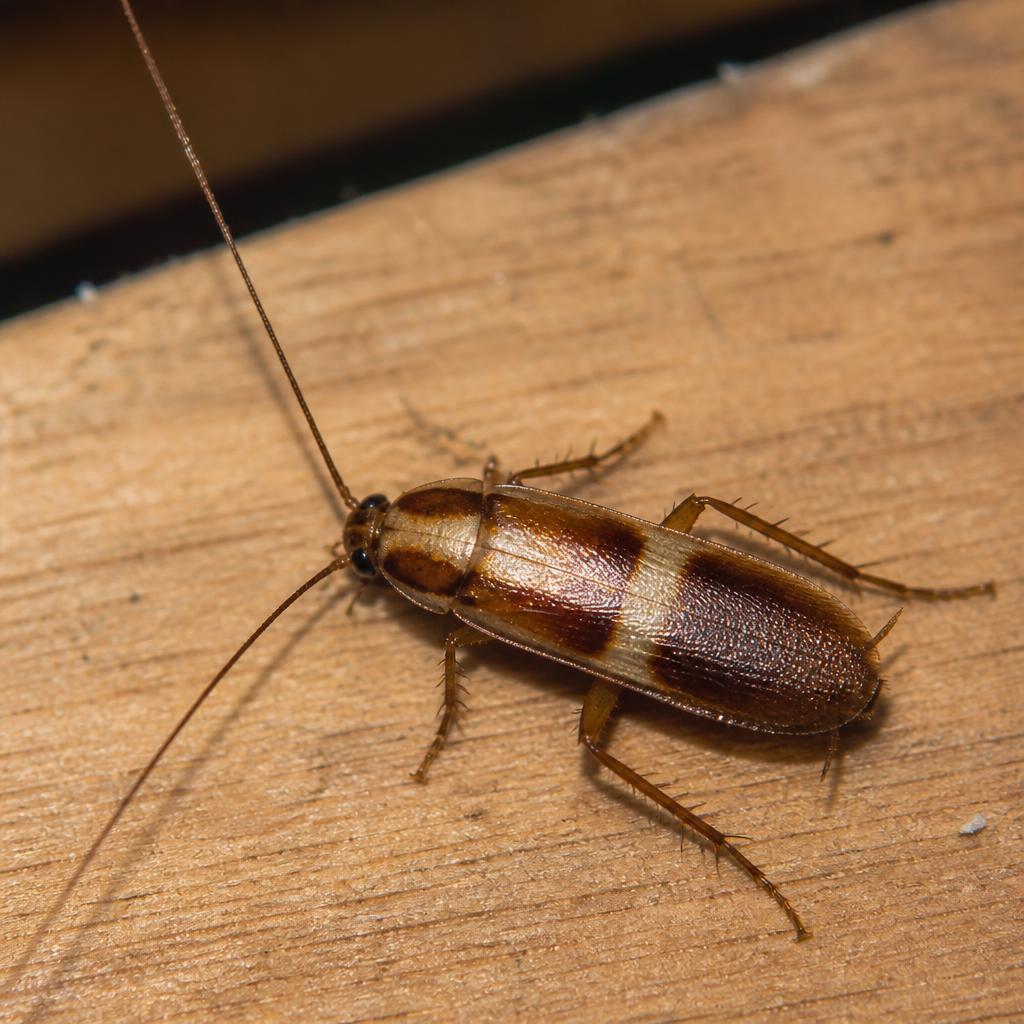
Cockroach
Brown-banded Cockroach
Supella longipalpa
Biology
Supella longipalpa, belonging to the Order Blattodea, are slender, light to dark brown cockroaches measuring 10–14 mm in length. They are uniquely identifiable by two distinct pale to yellowish-brown bands running transversely across the pronotum and abdominal segments, which are often more conspicuous on nymphs and females. The ootheca, a characteristic egg case, is reddish-brown, approximately 4–5 mm long, containing 10–18 eggs, and is typically glued to concealed surfaces. Under optimal conditions (25°C–30°C, 60–80% RH), the lifecycle from egg to adult averages 90–120 days, but can extend significantly up to 276 days in cooler environments. Adults live approximately 3–10 months, with females producing 5–18 oothecae in their lifetime, highlighting their moderate reproductive potential compared to species like the German cockroach.
Behaviour
Brown-banded cockroaches are primarily nocturnal, retreating to harborage sites during daylight hours and emerging after dusk to forage. Unlike many other cockroach species, they exhibit limited social structures, with interactions largely revolving around mating and competition for resources. Dispersal within a structure is a key behavioral trait, often driven by resource availability and harborage disturbance, leading to widespread infestations rather than concentrated populations. Communication primarily occurs through cuticular hydrocarbons and pheromones, influencing aggregation and sexual attraction, particularly during mating rituals. Their omnivorous diet includes a wide range of organic materials, with a preference for starchy foods, making them a general nuisance pest. While not directly aggressive, their presence can trigger allergic reactions and asthma in sensitive individuals due to shed exoskeletons and droppings, impacting public health.
Habits
These cockroaches prefer warm, dry conditions, often occupying elevated harborage sites such as the upper cabinets, behind wall decorations, within electronic equipment (e.g., televisions, computers, clocks), and inside furniture throughout a structure. Their foraging patterns are non-localized, allowing them to exploit food sources widely dispersed across a property. Unlike moisture-dependent species, they do not require proximity to water sources, enabling them to infest drier areas like bedrooms and living rooms. Conducive conditions for infestation include clutter providing ample harborage, readily available dry food sources, and sustained indoor temperatures above 20°C. Technicians should look for fecal spotting (tiny, dark specks), shed nymphal skins in elevated, concealed locations, and the characteristic glued oothecae on the undersides of furniture, appliance crevices, or other high-level hiding spots.
Control methods
- 1Apply gel baits in upper cabinets and behind electronics
- 2IGRs to disrupt development
- 3Vacuum and discard egg cases
- 4Inspect furniture seams during introductions
- 5Reduce clutter on shelves and closets
- 6Sticky monitors high and low
Tailored to Brown-banded Cockroach
IPM Procedure Checklist
Inspection
- Survey interior and exterior for evidence and conducive conditions
- Document findings with photos and a site map
- Place monitors to confirm activity
Identification
- Confirm Brown-banded Cockroach (Supella longipalpa) — not a look-alike
- Note life stage and risk level: Moderate
- Capture clear photos and samples for the record
Action Thresholds
- Trigger action when monitor counts trend up
- Re-evaluate weekly during active season
- Document trigger criteria in the IPM plan
Prevention
- Exclude entry points and harborage
- Improve sanitation and moisture control
- Modify habitat around the structure
Control Methods
- Apply gel baits in upper cabinets and behind electronics
- IGRs to disrupt development
- Vacuum and discard egg cases
- Inspect furniture seams during introductions
Monitoring & Evaluation
- Service monitors on schedule and trend captures
- Re-inspect for Brown-banded Cockroach activity at follow-up
- Adjust tactics based on data; report findings to client