Occasional Invader
Boxelder Bug
Boisea trivittata
Biology
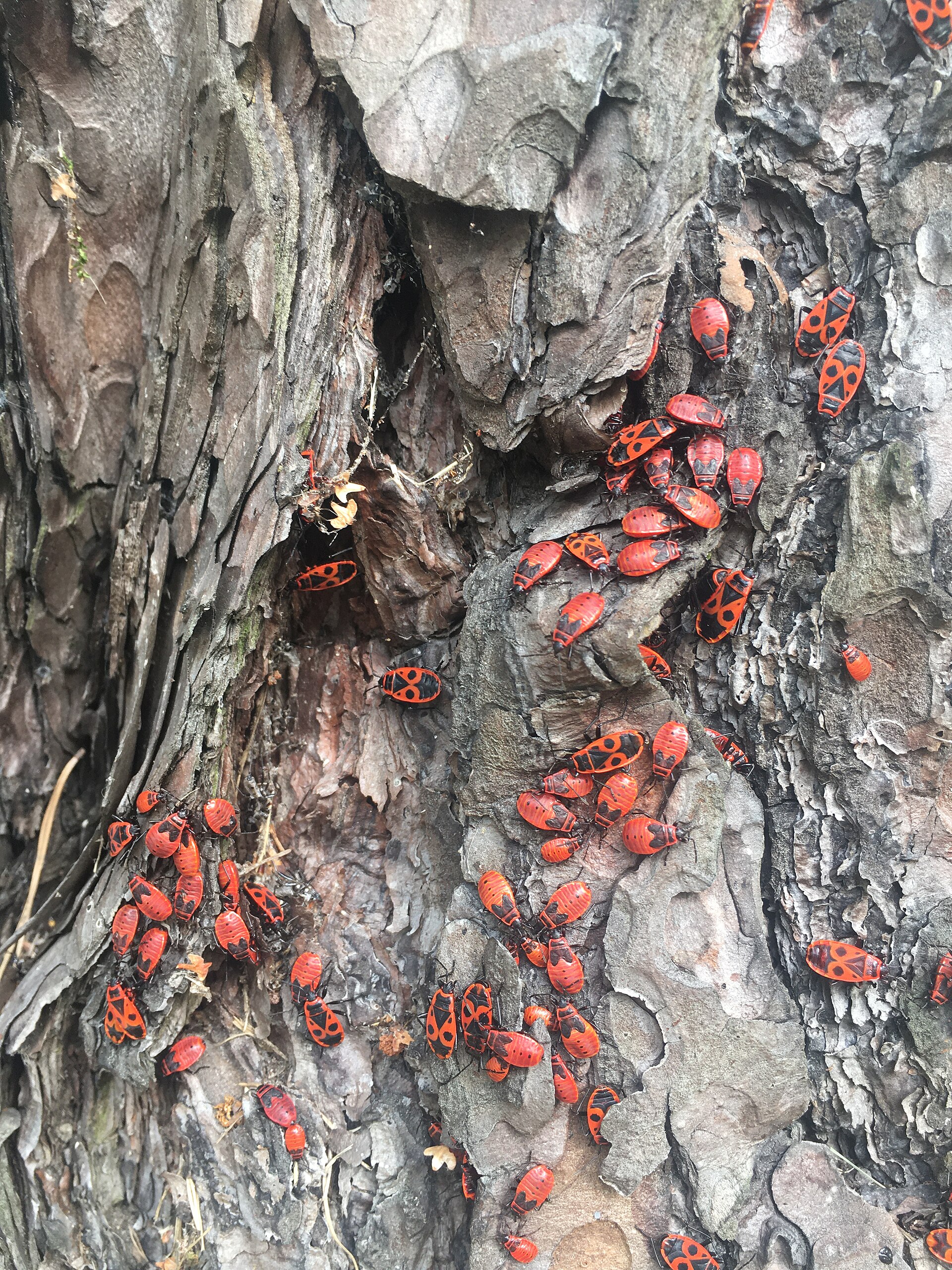
The boxelder bug, *Boisea trivittata*, is a true bug (Hemiptera: Rhopalidae), distinct from beetles by its piercing-sucking mouthparts and hemimetabolous metamorphosis. Adults measure 10-14 mm in length, characterized by a predominantly black dorsal surface adorned with three prominent red-orange longitudinal stripes on the pronotum and similarly colored veins along the outer margins of the forewings (hemelytra). Eggs hatch into bright red nymphs with black appendages, progressing through five instars over 28-30 days at optimal temperatures (25-30°C). A single female can lay 200-300 eggs, typically in clusters on host plant leaves or bark, with one to two generations per year depending on climate – often two in warmer, southern regions. Overwintering adults can live for several months, while a new generation of adults has a much shorter lifespan once reproduction occurs.
Behaviour
Boxelder bugs are primarily diurnal, actively feeding and basking during daylight hours, especially on sunny surfaces. Their social structure is largely aggregation-based, particularly evident during fall migration and overwintering, though they do not form eusocial colonies. Communication for aggregation primarily involves visual cues (e.g., sun-warmed surfaces) and possibly contact pheromones, though specific long-range aggregation pheromones are not well-documented. Their feeding ecology is specialized; nymphs and adults utilize piercing-sucking mouthparts to extract sap from the seeds, leaves, and tender twigs of host trees, primarily boxelder (Acer negundo), but also other maples (Acer spp.) and ash (Fraxinus spp.). While generally harmless to humans, large aggregations can be a nuisance, and when crushed, they emit a distinctive, pungent odor and orange-red stain, which can mark surfaces or fabrics.
Habits
Boxelder bugs preferentially harbor in protected, dry, and often sun-exposed areas during cooler months, primarily seeking overwintering sites in wall voids, attics, soffits, and under siding—especially on south and west-facing aspects of structures. Foraging patterns during the active season involve movement between host trees for feeding and basking on warm surfaces. In late summer and early fall, as temperatures decline and host trees begin senescence, adults display a strong migratory urge, flying considerable distances to aggregate on the exterior of structures. Conducive conditions for large aggregations near homes include the presence of seed-bearing boxelder or maple trees within 1-2 blocks, along with unsealed entry points into the structure. Technicians should look for dark reddish-brown fecal streaks on light-colored surfaces near entry points, the distinctive odor when large numbers are present, and the physical presence of live or dead insects around windows, doors, and ledges, particularly on warm, sunny winter days as they become active.
Control methods
- 1Seal cracks, vents and gaps before October
- 2Vacuum interior bugs — do not crush (stains)
- 3Remove female boxelder trees if practical
- 4Spot pyrethroid treatment of fall aggregations
- 5Repair window screens and door sweeps
- 6Caulk siding-to-fascia gaps
Tailored to Boxelder Bug
IPM Procedure Checklist
Inspection
- Inspect exterior perimeter for entry pathways
- Note moisture, mulch and ground-cover near foundation
- Identify aggregation sites on warm walls
Identification
- Confirm Boxelder Bug (Boisea trivittata) — not a look-alike
- Note life stage and risk level: Low
- Capture clear photos and samples for the record
Action Thresholds
- Tolerate low-level activity outside sensitive zones
- Act if activity moves indoors or near food
- Review threshold seasonally with the client
Prevention
- Seal foundation cracks, weep holes and utility penetrations
- Pull mulch and vegetation back from the structure
- Improve drainage and reduce exterior moisture
Control Methods
- Seal cracks, vents and gaps before October
- Vacuum interior bugs — do not crush (stains)
- Remove female boxelder trees if practical
- Spot pyrethroid treatment of fall aggregations
Monitoring & Evaluation
- Service monitors on schedule and trend captures
- Re-inspect for Boxelder Bug activity at follow-up
- Adjust tactics based on data; report findings to client