Occasional Invader
Black Vine Weevil
Otiorhynchus sulcatus
Biology
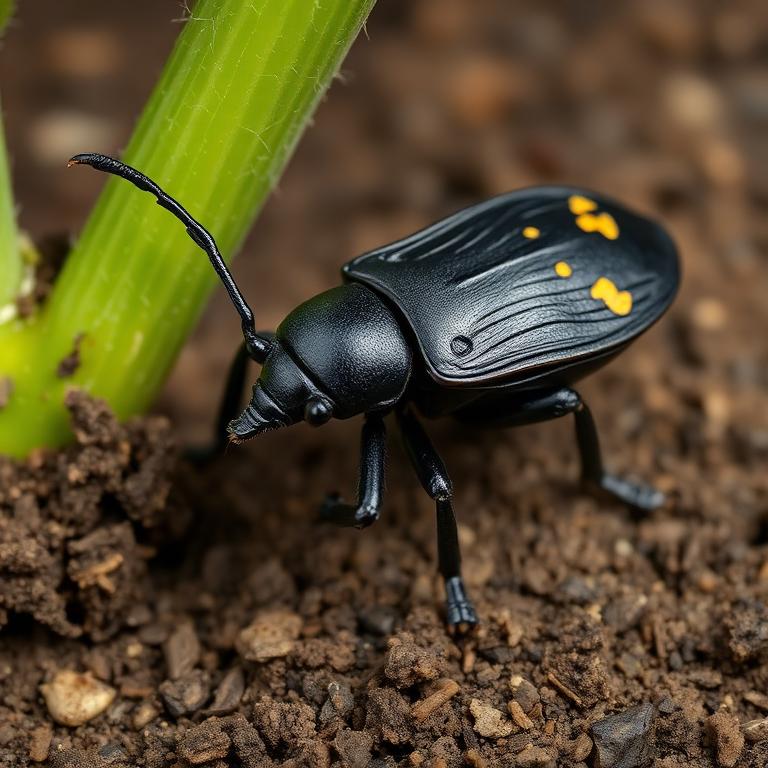
The black vine weevil (Curculionidae) is a flightless, matte-black weevil 8–12 mm long with fused elytra, a short broad snout, elbowed antennae, and pitted wing covers bearing small patches of yellowish hairs. Populations are almost entirely female and reproduce parthenogenetically — no males are needed — so a single introduced individual can found an infestation. Each female lays 200–500 eggs in soil near host plants over the summer. Legless, C-shaped white larvae with tan heads feed on roots through the autumn, overwinter in soil, and pupate in spring; adults emerge from late spring into summer and live several months, with one generation per year.
Behaviour
Adults are strictly nocturnal, hiding in soil, mulch, and leaf litter by day and climbing plants at night to feed. Their diagnostic damage is crescent-shaped notching along leaf margins of yew, rhododendron, azalea, euonymus, hemlock, and strawberry. The serious injury, however, is below ground: larvae girdle roots and crowns, causing wilt and sudden plant death. They do not bite, sting, or damage building materials and cannot reproduce indoors. Because they cannot fly, indoor specimens have walked in — which usefully narrows the entry inspection to ground-level gaps.
Habits
Harborage is mulch, dense ground cover, and container nursery stock pressed against foundations; adults wander indoors mainly in early summer and again in autumn, entering under doors, through weep holes, foundation cracks, sliding-door tracks, and around basement window wells. Conducive conditions include heavy mulch beds against the wall, susceptible foundation plantings such as yew and rhododendron, and recently installed nursery stock, which is the usual route of introduction. Inspect foundation plantings for marginal leaf notching, sift mulch and topsoil for larvae around declining plants, and place glueboards along basement and ground-floor wall junctions.
Control methods
- 1Inspect incoming nursery stock — the usual route of introduction
- 2Pull mulch back 300 mm and thin dense foundation plantings
- 3Seal ground-level gaps: door sweeps, weep holes, foundation cracks, window wells
- 4Apply entomopathogenic nematodes to soil for larvae in late summer
- 5Night inspection of foundation plants to confirm adult activity
- 6Targeted perimeter residual band during early-summer adult emergence
Tailored to Black Vine Weevil
IPM Procedure Checklist
Inspection
- Inspect exterior perimeter for entry pathways
- Note moisture, mulch and ground-cover near foundation
- Identify aggregation sites on warm walls
Identification
- Confirm Black Vine Weevil (Otiorhynchus sulcatus) — not a look-alike
- Note life stage and risk level: Low
- Capture clear photos and samples for the record
Action Thresholds
- Tolerate low-level activity outside sensitive zones
- Act if activity moves indoors or near food
- Review threshold seasonally with the client
Prevention
- Seal foundation cracks, weep holes and utility penetrations
- Pull mulch and vegetation back from the structure
- Improve drainage and reduce exterior moisture
Control Methods
- Inspect incoming nursery stock — the usual route of introduction
- Pull mulch back 300 mm and thin dense foundation plantings
- Seal ground-level gaps: door sweeps, weep holes, foundation cracks, window wells
- Apply entomopathogenic nematodes to soil for larvae in late summer
Monitoring & Evaluation
- Service monitors on schedule and trend captures
- Re-inspect for Black Vine Weevil activity at follow-up
- Adjust tactics based on data; report findings to client