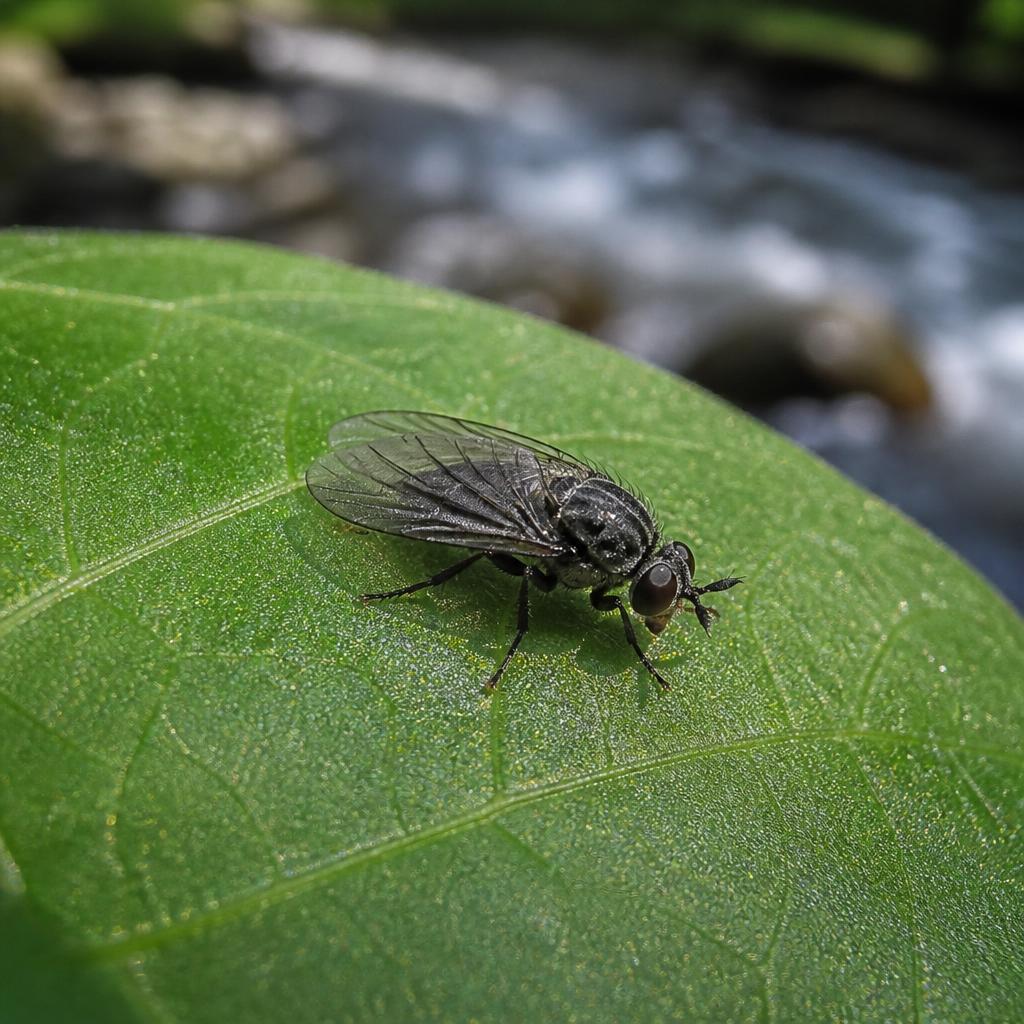
Blood Feeder
Black Fly
Simuliidae
Biology
Black flies belong to the family Simuliidae, a ubiquitous group of small, robust dipterans typically measuring 1-5 mm. Their characteristic features include a short, stout body, a pronounced humped thorax, and broad, clear wings with robust venation. Reproduction is obligately aquatic, with females laying clutches of 100-800 eggs directly into flowing water or on submerged vegetation. The larval stage, lasting from a few weeks to several months depending on species and environmental conditions, involves 6-9 instars, during which they filter-feed on microscopic organisms. Pupation occurs in a dome-shaped silken cocoon attached to submerged substrates, with adult emergence typically synchronized in massive, seasonal swarms often triggered by specific temperature and photoperiod cues, particularly in temperate regions.
Behaviour
Adult female black flies are diurnal, obligate anautogenous blood-feeders, meaning they require a blood meal for ovarian development and egg production. They are primarily exophilic, exhibiting crepuscular or mid-day biting peaks, often targeting exposed skin around the head, ears, neck, and limbs of avian and mammalian hosts. Their communication largely involves chemical cues, with host-seeking females employing visual and olfactory stimuli (e.g., CO2, lactic acid, heat) to locate hosts. While generally non-aggressive towards humans in a defensive context, their persistent swarming and vicious bites can induce severe irritation, allergic reactions, and in some individuals, a systemic toxemia known as 'black fly fever' characterized by headache, nausea, and lymphadenopathy. In endemic tropical regions, certain species are significant vectors of onchocerciasis (river blindness) caused by the filarial nematode Onchocerca volvulus, transmitting microfilariae during blood-feeding.
Habits
Black fly habitats are intrinsically linked to pristine, oxygen-rich, fast-flowing aquatic environments such as rivers, streams, and spillways, where their larvae attach to submerged rocks, vegetation, and debris using a caudal suction disc. Adult males are nectar feeders and remain close to emergence sites, while blood-questing females can disperse several kilometers from their natal streams, often aided by wind currents. Infestations are typically seasonal, peaking in late spring to early summer in temperate zones and during rainy seasons in the tropics, correlating with optimal environmental conditions for larval development and adult emergence. Key indications of an infestation include the characteristic itchy, painful papules and local swelling resulting from bites, and the visual presence of dense swarms of small, dark, humpbacked flies, particularly near riparian zones or around livestock enclosures.
Control methods
- 1DEET or picaridin repellent on exposed skin
- 2Wear light-colored, tightly woven long sleeves
- 3Schedule outdoor work for windy or midday hours
- 4Head net during peak emergence
- 5Avoid wooded streamside areas in late spring
- 6Seal screens and entry points around doors
Tailored to Black Fly
IPM Procedure Checklist
Inspection
- Survey interior and exterior for evidence and conducive conditions
- Document findings with photos and a site map
- Place monitors to confirm activity
Identification
- Confirm Black Fly (Simuliidae) — not a look-alike
- Note life stage and risk level: Moderate
- Capture clear photos and samples for the record
Action Thresholds
- Trigger action when monitor counts trend up
- Re-evaluate weekly during active season
- Document trigger criteria in the IPM plan
Prevention
- Exclude entry points and harborage
- Improve sanitation and moisture control
- Modify habitat around the structure
Control Methods
- DEET or picaridin repellent on exposed skin
- Wear light-colored, tightly woven long sleeves
- Schedule outdoor work for windy or midday hours
- Head net during peak emergence
Monitoring & Evaluation
- Service monitors on schedule and trend captures
- Re-inspect for Black Fly activity at follow-up
- Adjust tactics based on data; report findings to client