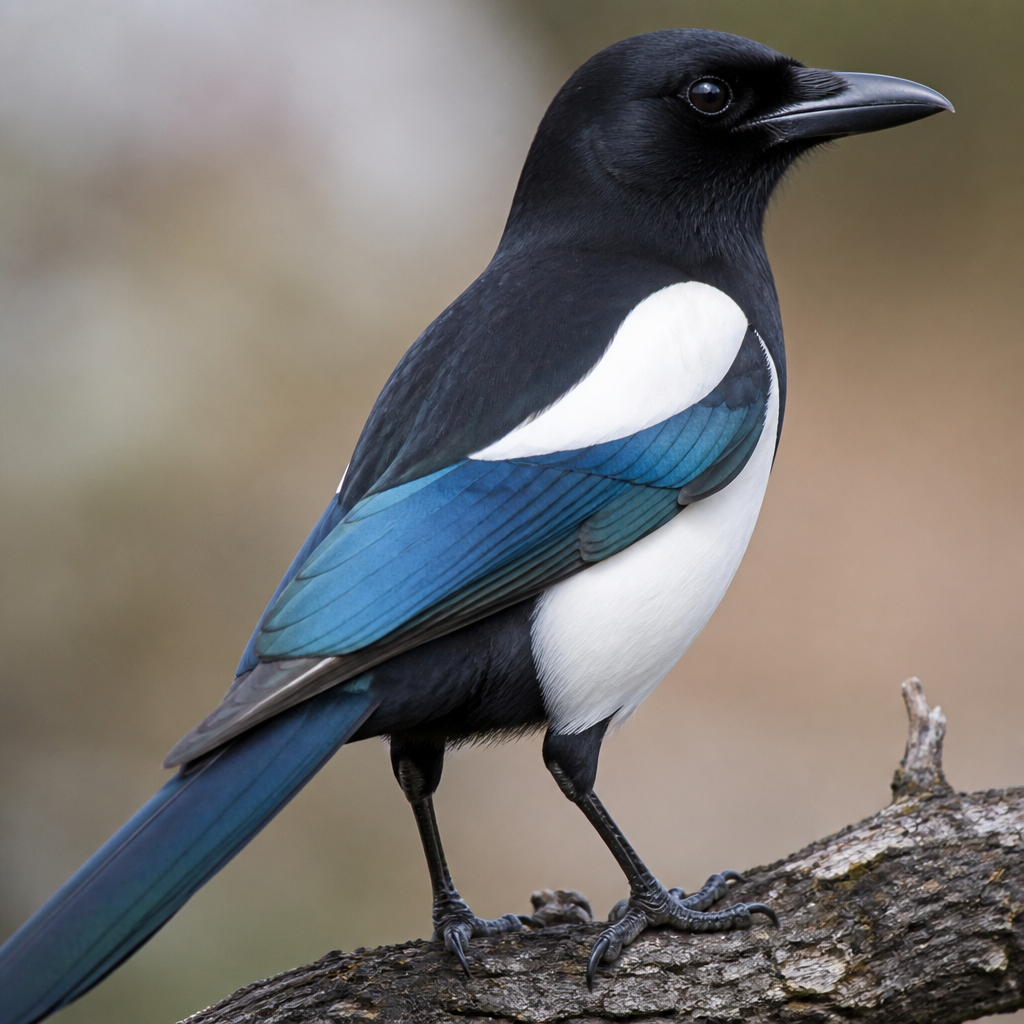
Bird
Black-billed Magpie
Pica hudsonia
Biology
The Black-billed Magpie, *Pica hudsonia*, is a New World corvid distinguished by its long, iridescent black-green tail, contrasting white scapulars, and overall size of 45-60 cm including the tail, which comprises over half its body length. They achieve sexual maturity around two years. Breeding occurs from March to July, with females laying a single clutch of 5-9 eggs (typically 6-7) in a large, domed stick nest lined with mud and fine grass, incubated for 16-22 days. Hatchlings are altricial, fledging at 24-30 days, and the species generally lives 4-6 years in the wild, though some individuals may reach 10 years. Chicks have a ~50% survival rate.
Behaviour
Magpies are highly social and exhibit complex communication, including a range of vocalisations from chattering alarm calls to softer contact calls, and elaborate body language with tail and wing flicks. While primarily diurnal, they can be active during twilight hours, especially when scavenging. They are known for their intelligent problem-solving, opportunistic foraging, and cache-recovery skills. They forage visually and tactilely, readily exploiting novel food sources and adapting to human-altered landscapes. Their aggressive nest-raiding behaviour, particularly targeting smaller songbird eggs and nestlings, and predation on young poultry or garden produce, makes them a significant pest concern. Flocks can number in the dozens, communicating to locate and exploit food sources effectively.
Habits
Black-billed Magpies prefer open country with scattered trees, riparian zones, and increasingly, suburban and urban environments where food and nesting sites are plentiful. Nests, robust and often bulky, are typically constructed 2-15 meters high in deciduous trees or dense shrubs, providing significant cover. Foraging patterns are eclectic, spanning a wide range for invertebrates, small vertebrates, carrion, and anthropogenic food waste. They are particularly drawn to areas with livestock, overflowing refuse bins, or exposed pet food. Infestations are often indicated by large, conspicuous nests, persistent chattering vocalizations, and the visible depredation of garden crops, exposed pet food, or small poultry. They frequently cache surplus food items in small pits, under leaves, or in tree crevices, which can later be excavated by other animals.
Control methods
- 1Cover compost and secure trash with locking lids
- 2Feed pets indoors; remove unfinished food
- 3Protect poultry runs with overhead netting
- 4Remove unused stick nests in winter
- 5Reflective deterrents and scare-eye balloons rotated weekly
- 6Permitted lethal control only where legally allowed
Tailored to Black-billed Magpie
IPM Procedure Checklist
Inspection
- Identify roosting, loafing and nesting sites
- Document droppings, feathers and damage to structure
- Note food and water sources attracting birds
Identification
- Confirm Black-billed Magpie (Pica hudsonia) — not a look-alike
- Note life stage and risk level: Low
- Capture clear photos and samples for the record
Action Thresholds
- Tolerate low-level activity outside sensitive zones
- Act if activity moves indoors or near food
- Review threshold seasonally with the client
Prevention
- Install spikes, netting or shock track on ledges
- Remove standing water and accessible food
- Close openings to attics, vents and signage voids
Control Methods
- Cover compost and secure trash with locking lids
- Feed pets indoors; remove unfinished food
- Protect poultry runs with overhead netting
- Remove unused stick nests in winter
Monitoring & Evaluation
- Service monitors on schedule and trend captures
- Re-inspect for Black-billed Magpie activity at follow-up
- Adjust tactics based on data; report findings to client