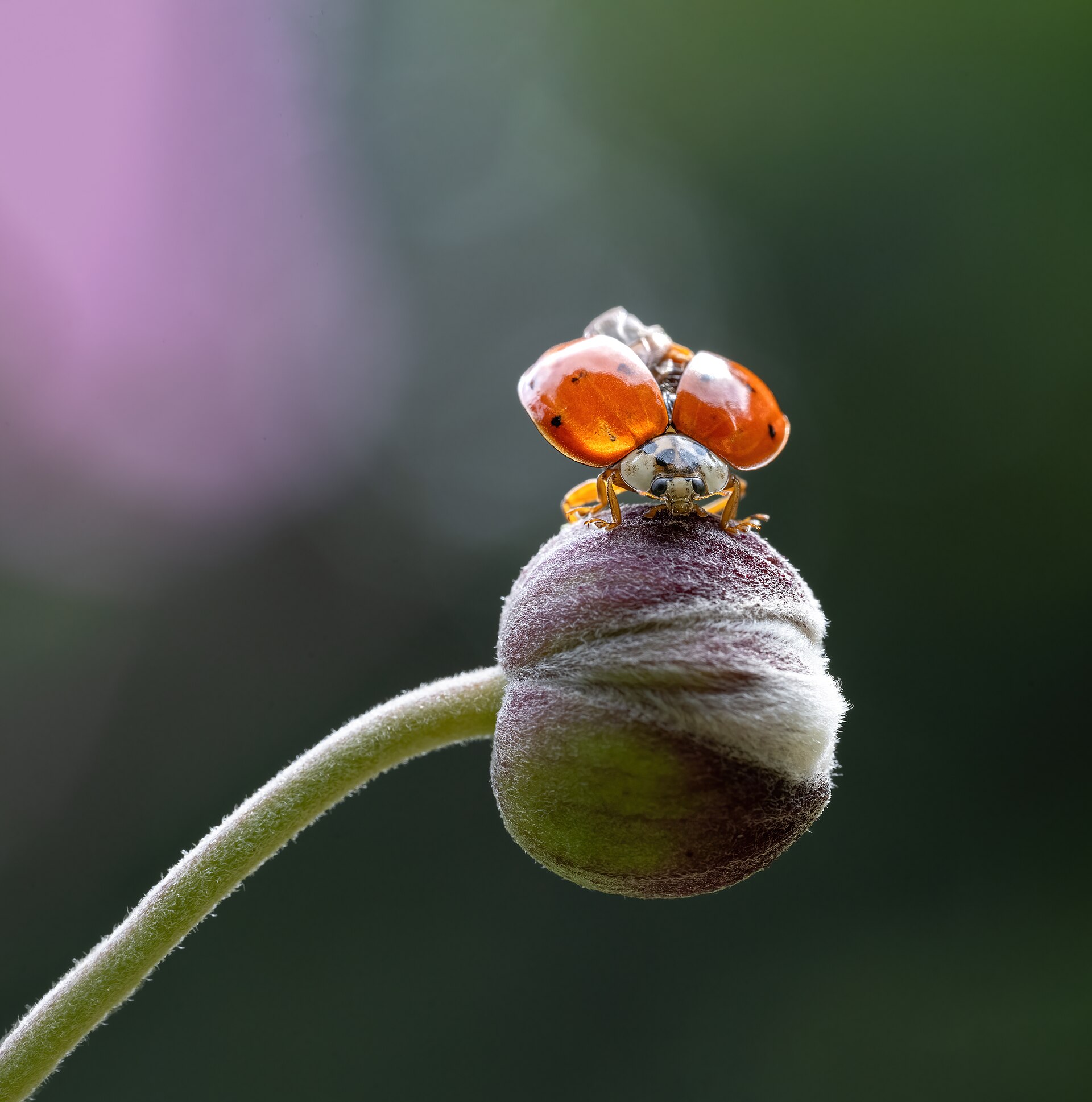
Occasional Invader
Asian Lady Beetle
Harmonia axyridis
Biology
The Asian lady beetle, *Harmonia axyridis*, belongs to the family Coccinellidae, order Coleoptera. Adults measure 5.5–8.5 mm in length and exhibit significant color polymorphism, ranging from pale orange to bright red, with 0 to 22 black spots; a characteristic M- or W-shaped black marking on the white pronotum is diagnostic. Its lifecycle comprises four stages: egg, larva (four instars), pupa, and adult, typically completed in 15–30 days depending on temperature and food availability. Females can lay up to 2,000 eggs over their 1–3 month lifespan, with optimal development occurring between 20–25°C and relative humidity of 60–80%. This high reproductive capacity contributes to its rapid establishment and spread in new environments.
Behaviour
Primarily diurnal hunters, *H. axyridis* are voracious predators of soft-bodied arthropods, particularly aphids, psyllids, and scale insects, consuming hundreds daily as both larvae and adults. During late summer and fall, as aphid populations decline and temperatures drop, they exhibit a strong aggregative instinct, releasing aggregation pheromones (e.g., harmoniaxydin) that draw thousands to overwintering sites. When disturbed or stressed, adults reflexively bleed hemolymph – a yellowish, acrid fluid containing toxic alkaloids (harmoniaxydin, harmonine) – from their leg joints. This 'reflex bleeding' stains surfaces and serves as a defense mechanism against predators, while also posing an ophthalmic contact risk to humans in mass aggregations.
Habits
As an occasional invader, *H. axyridis* typically seeks harborage in wall voids, attics, soffits, and window/door frames as outdoor temperatures decrease, selecting structures that provide solar exposure and thermal insulation. Their overwintering aggregations are frequently observed on the sunny, south-facing sides of buildings, where they exploit small cracks and crevices for entry; aggregations can number in the thousands or even millions in severe infestations. Foraging patterns during warmer months are primarily arboreal and field-based, following aphid populations. Elevated CO2 levels within structures, along with contrasting light-colored surfaces adjacent to dark entry points, are considered conducive conditions that attract overwintering adults.
Control methods
- 1Seal exterior gaps and replace torn screens
- 2Vacuum aggregations indoors with dedicated bag
- 3Light traps in attics during winter
- 4Spot treat siding aggregations in October
- 5Avoid crushing — stains painted surfaces
- 6Tolerate outdoors as a beneficial predator
Tailored to Asian Lady Beetle
IPM Procedure Checklist
Inspection
- Inspect exterior perimeter for entry pathways
- Note moisture, mulch and ground-cover near foundation
- Identify aggregation sites on warm walls
Identification
- Confirm Asian Lady Beetle (Harmonia axyridis) — not a look-alike
- Note life stage and risk level: Low
- Capture clear photos and samples for the record
Action Thresholds
- Tolerate low-level activity outside sensitive zones
- Act if activity moves indoors or near food
- Review threshold seasonally with the client
Prevention
- Seal foundation cracks, weep holes and utility penetrations
- Pull mulch and vegetation back from the structure
- Improve drainage and reduce exterior moisture
Control Methods
- Seal exterior gaps and replace torn screens
- Vacuum aggregations indoors with dedicated bag
- Light traps in attics during winter
- Spot treat siding aggregations in October
Monitoring & Evaluation
- Service monitors on schedule and trend captures
- Re-inspect for Asian Lady Beetle activity at follow-up
- Adjust tactics based on data; report findings to client