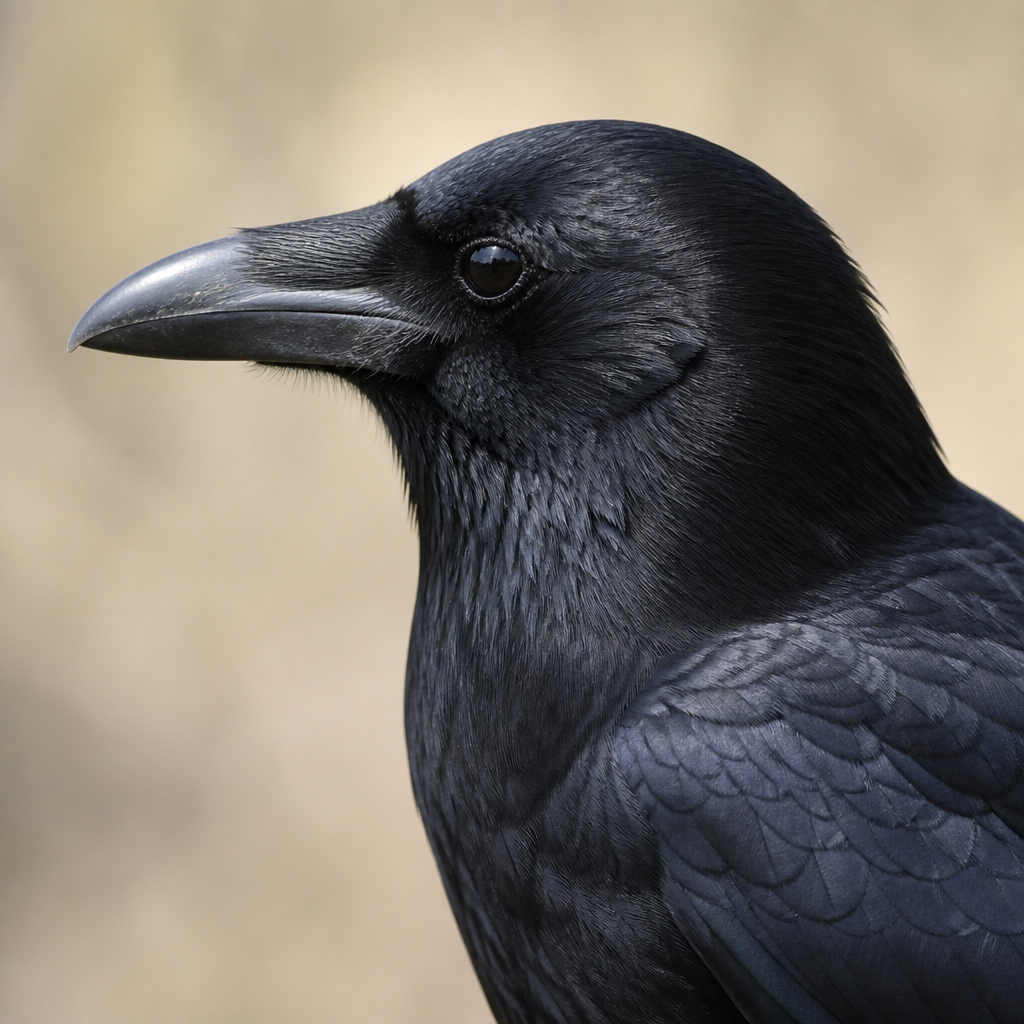
Bird
American Crow
Corvus brachyrhynchos
Biology
The American Crow, taxonomic designation *Corvus brachyrhynchos*, is a passerine bird belonging to the family Corvidae. Adults measure 40-50 cm in length with a wingspan of 90-100 cm and weigh approximately 300-600 grams, displaying entirely iridescent black plumage, including the bill, legs, and feet. Their breeding season typically occurs from March to May, with females laying 3-6 eggs (average clutch size 4) that hatch after an 18-day incubation period, predominantly by the female. Juveniles fledge at about 35 days, remaining dependent on parental care for several weeks. Their average lifespan in the wild is 7-8 years, though individuals can live over 20 years, with high mortality in their first year; West Nile virus is a significant natural mortality factor, particularly for immunocompromised individuals.
Behaviour
American Crows exhibit remarkable cognitive abilities, including problem-solving, tool use, and facial recognition, contributing to their adaptability and success in diverse environments. They form complex social structures, often living in family units that cooperatively rear young, with non-breeding adults or offspring from previous years assisting in nest defense and provisioning. Their vocalizations are highly varied and communicate warnings, aggregation signals, and territorial claims; these calls can cover a frequency range of 0.5-5 kHz. During the day, they forage widely, but at dusk, thousands of individuals may converge on communal winter roosts, primarily for predator avoidance and information sharing on foraging sites. These large roosts, often in urban trees, can lead to significant public health and amenity impacts due to accumulated droppings directly below.
Habits
American Crows are opportunistic omnivores, with their diet encompassing carrion, insects, small vertebrates, eggs, nestlings, grains, fruits, and refuse. Their foraging patterns are typically diurnal, covering extensive ranges—often several kilometers from their roost sites—and they quickly learn to exploit new food sources, including agricultural crops and unsecured waste receptacles. During colder months, they form large, often transient, communal roosts in dense stands of trees, frequently in urban or suburban areas, providing both thermal efficiency and increased vigilance against predators. The presence of numerous whitewash accumulations, discarded food items, and persistent loud vocalizations, particularly at dawn and dusk, are clear indicators of crow activity and potential roosting sites, necessitating a thorough survey of tree canopy and surrounding open areas for specific impact assessment.
Control methods
- 1Pyrotechnics, lasers and distress calls to disperse roosts (rotate)
- 2Selective tree thinning to reduce roost cover
- 3Cover ripening crops with bird netting
- 4Secure refuse in lidded containers
- 5Reflective tape or balloons near orchards and feedlots
- 6Protect songbird nest boxes with predator guards
Tailored to American Crow
IPM Procedure Checklist
Inspection
- Identify roosting, loafing and nesting sites
- Document droppings, feathers and damage to structure
- Note food and water sources attracting birds
Identification
- Confirm American Crow (Corvus brachyrhynchos) — not a look-alike
- Note life stage and risk level: Moderate
- Capture clear photos and samples for the record
Action Thresholds
- Trigger action when monitor counts trend up
- Re-evaluate weekly during active season
- Document trigger criteria in the IPM plan
Prevention
- Install spikes, netting or shock track on ledges
- Remove standing water and accessible food
- Close openings to attics, vents and signage voids
Control Methods
- Pyrotechnics, lasers and distress calls to disperse roosts (rotate)
- Selective tree thinning to reduce roost cover
- Cover ripening crops with bird netting
- Secure refuse in lidded containers
Monitoring & Evaluation
- Service monitors on schedule and trend captures
- Re-inspect for American Crow activity at follow-up
- Adjust tactics based on data; report findings to client