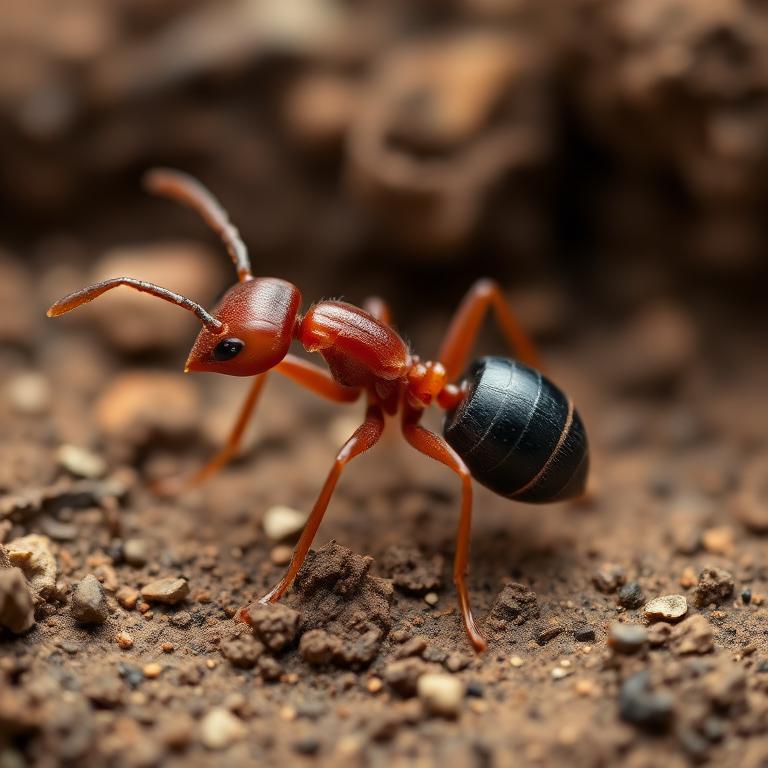
Ant
Allegheny Mound Ant
Formica exsectoides
Biology
Allegheny mound ants are robust Formica workers 3–8 mm long with a red-orange head and thorax contrasting sharply with a dark brown-black gaster. Colonies are strongly polygynous and long-lived, and are famous for building dome-shaped soil mounds that can exceed 1 m in height and 2 m across, housing tens of thousands of workers. The mound acts as a solar incubator, and brood is shuttled between chambers through the day to track temperature. Winged reproductives are produced in early summer, and new colonies form mainly by budding, so a single site typically develops a cluster of connected mounds over several years.
Behaviour
Workers are day-active, aggressive when the mound is disturbed, and will bite and spray formic acid into the wound, producing a burning sensation rather than a true sting. Foraging is dominated by honeydew from aphids and scale insects, which the ants tend and protect, supplemented by scavenged and captured insects. To protect their sunlit mound they inject formic acid into nearby woody stems, killing saplings, shrubs and ornamentals within about 12 m of the nest — the most economically important damage this species causes.
Habits
Mounds are built in open, sunny ground: pastures, fields, utility rights-of-way, embankments, golf-course roughs, orchards, and unmowed lawn edges, typically in well-drained sandy or loamy soil. They are rarely a true indoor pest, but foraging workers enter adjacent buildings and their mounds obstruct mowing and damage landscape plantings. Inspection is straightforward — locate the mounds and map satellite nests, then follow trails to aphid-infested trees and shrubs, which are the food base sustaining the colony.
Control methods
- 1Locate and map all mounds and satellite nests before treatment
- 2Treat the mound directly with a labelled drench so it reaches the queens
- 3Use granular or gel ant bait carried back into the mound
- 4Control aphids and scale on nearby trees to remove the honeydew supply
- 5Mow and open up vegetation to reduce sunny mound-building ground
- 6Re-inspect for satellite mounds — budding rebuilds untreated colonies
Tailored to Allegheny Mound Ant
IPM Procedure Checklist
Inspection
- Follow trails to nests, food and moisture sources
- Inspect wall voids, slab edges and exterior soil
- Place non-repellent monitors at trail crossings
Identification
- Confirm Allegheny Mound Ant (Formica exsectoides) — not a look-alike
- Note life stage and risk level: Moderate
- Capture clear photos and samples for the record
Action Thresholds
- Trigger action when monitor counts trend up
- Re-evaluate weekly during active season
- Document trigger criteria in the IPM plan
Prevention
- Seal entry cracks, utility penetrations and weep holes
- Eliminate honeydew-producing pests on landscape plants
- Store food in sealed containers and clean spills promptly
Control Methods
- Locate and map all mounds and satellite nests before treatment
- Treat the mound directly with a labelled drench so it reaches the queens
- Use granular or gel ant bait carried back into the mound
- Control aphids and scale on nearby trees to remove the honeydew supply
Monitoring & Evaluation
- Service monitors on schedule and trend captures
- Re-inspect for Allegheny Mound Ant activity at follow-up
- Adjust tactics based on data; report findings to client