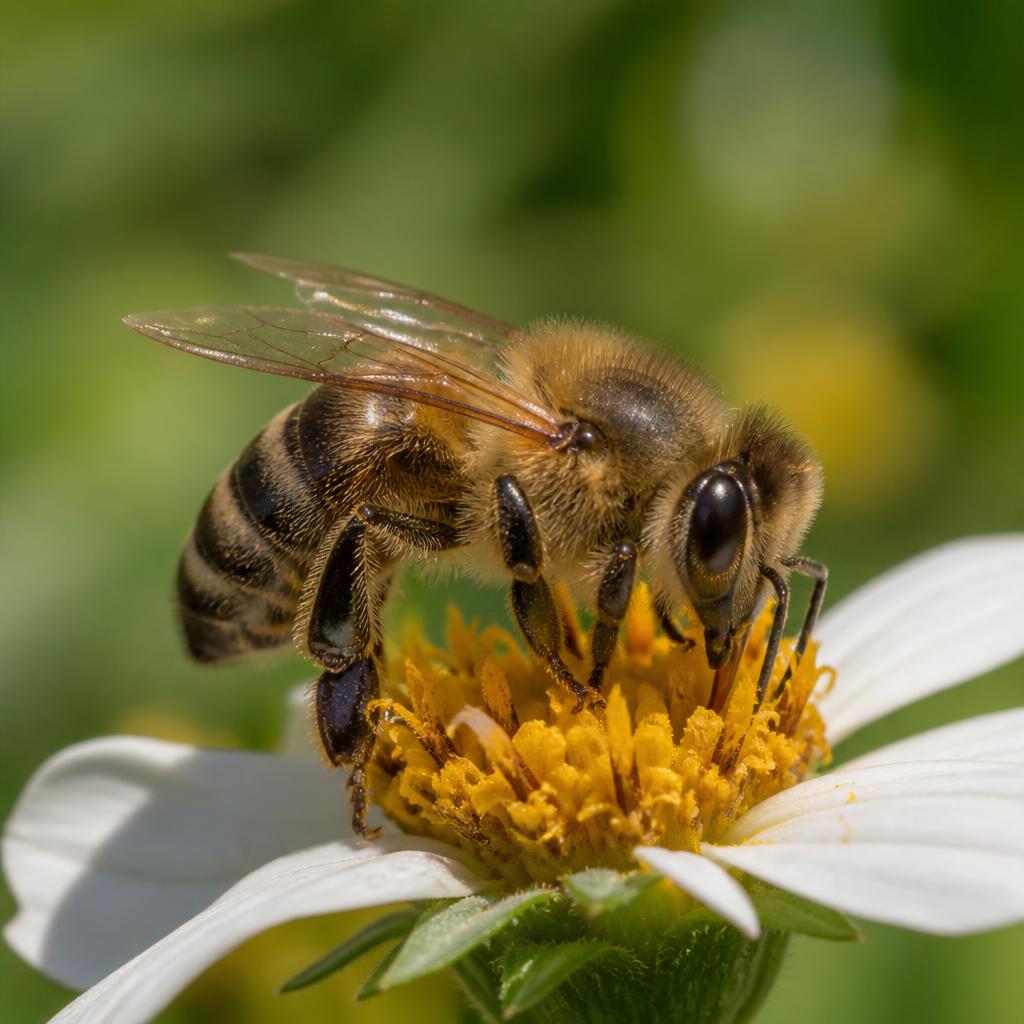
Stinging Insect
Africanized Honey Bee
Apis mellifera scutellata
Biology
Africanized honey bees (AHB), Apis mellifera scutellata, are a hybrid subspecies resulting from the interbreeding of African and European honey bees, first introduced to Brazil in 1956. While visually nearly indistinguishable from European honey bees (EHB) to the untrained eye—sharing similar black and yellow striped abdomens—AHB workers are marginally smaller, averaging 10-12 mm in length. Their lifecycle, from egg to adult, typically spans 20-22 days, with queens living 1-2 years and workers 4-6 weeks during active seasons. AHB queens exhibit a higher reproductive rate, laying up to 2,000 eggs per day, contributing to rapid colony growth. These bees thrive in warmer climates, preferring temperatures between 25-35°C and showing less tolerance for prolonged cold than their European counterparts.
Behaviour
Africanized honey bees display heightened defensiveness, acting as a significant public health threat due to their propensity for mass stinging. When disturbed, they mobilize a much larger percentage of their colony (up to 10-20 times more bees than EHB) and will pursue perceived threats for distances exceeding 400 meters. Their alarm pheromone, isoamyl acetate, is released in greater quantities and persists longer, leading to a more sustained and aggressive response. They exhibit increased swarming and absconding behaviors, enabling rapid dispersal and colonization of new areas. Their venom composition is identical to EHB; however, the sheer volume of stings delivered amplifies the risk of anaphylaxis and envenomation-related fatalities in humans and animals.
Habits
AHB colonies are highly adaptable, exhibiting opportunistic nesting habits in diverse locations, including tree cavities, rock crevices, utility boxes, abandoned vehicles, and even subterranean voids. They show a greater tendency to abscond (abandon a nest) or swarm, often migrating several times a year in response to resource availability or perceived threats. Foraging patterns are extensive, with workers collecting nectar and pollen up to 5 km from the hive, though typically within 1-2 km. Conducive conditions for establishment include sheltered cavities with small entrance holes (1-5 cm in diameter) and proximity to water and flowering vegetation. Pest management professionals should look for signs of increased bee activity around structures, dark staining (propolis/feces) near entry points, and an overly aggressive response to vibrations or movement near potential harborage.
Control methods
- 1Never approach or disturb a wild hive
- 2Run in a straight line to enclosed shelter if attacked
- 3Use only licensed professional removal
- 4Inspect property monthly for new colonies in spring
- 5Seal cavities, soffits and utility boxes >1/8 in.
- 6Educate household and workers on response
Tailored to Africanized Honey Bee
IPM Procedure Checklist
Inspection
- Survey interior and exterior for evidence and conducive conditions
- Document findings with photos and a site map
- Place monitors to confirm activity
Identification
- Confirm Africanized Honey Bee (Apis mellifera scutellata) — not a look-alike
- Note life stage and risk level: Severe
- Capture clear photos and samples for the record
Action Thresholds
- Zero-tolerance: act on first confirmed sighting
- Notify client and document the trigger event
- Prioritize health and regulatory risk in the plan
Prevention
- Exclude entry points and harborage
- Improve sanitation and moisture control
- Modify habitat around the structure
Control Methods
- Never approach or disturb a wild hive
- Run in a straight line to enclosed shelter if attacked
- Use only licensed professional removal
- Inspect property monthly for new colonies in spring
Monitoring & Evaluation
- Service monitors on schedule and trend captures
- Re-inspect for Africanized Honey Bee activity at follow-up
- Adjust tactics based on data; report findings to client